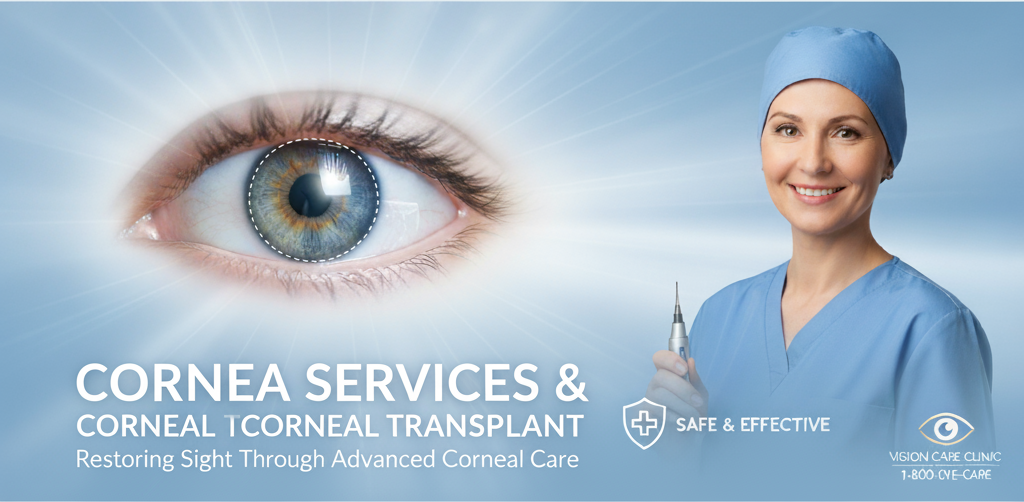
Cornea Services & Corneal Transplant
Dedicated specialty care for the cornea, the eye's primary focusing lens. We offer advanced medical and surgical solutions for conditions like Keratoconus, infections, and corneal failure.
What is the Cornea and Why is it Important?
The cornea is the transparent, dome-shaped front part of the eye that covers the iris, pupil, and anterior chamber. It acts as the window of the eye and provides approximately two-thirds of the eye's focusing power. When the cornea is damaged, scarred, or loses its regular shape, vision becomes drastically blurred.
Our Cornea Services specialize in restoring the clarity and regular curvature of this vital structure, ranging from managing severe eye infections to complex corneal transplantation surgery.
Why Choose Our Cornea Care?
- Expertise in managing Keratoconus with C3R and specialized contact lenses
- Immediate, 24/7 care for painful corneal ulcers and infections
- Access to the latest partial-thickness Corneal Transplant (DSEK, DALK) techniques
- Advanced diagnostic equipment: Topography, Pachymetry, and Specular Microscopy
- Pre-operative assessment for refractive surgeries (LASIK/PRK) eligibility

Corneal Mapping
Topography for KeratoconusKeratoplasty
Corneal Replacement SurgeryKey Corneal Diseases We Treat
Restoring the clarity, strength, and health of the corneal tissue
Keratoconus
Progressive thinning and steepening of the cornea into a cone shape, causing blurred and distorted vision. Stabilized with C3R.
Corneal Ulcers & Infections
Severe infections (bacterial, fungal, viral) of the cornea. A time-sensitive emergency requiring aggressive diagnosis and antibiotic/antifungal therapy.
Corneal Dystrophies & Degenerations
Genetic conditions (like Fuch’s Dystrophy) that cause corneal clouding, swelling, or breakdown, eventually requiring transplantation.
Chemical/Thermal Injuries
Treatment for severe corneal damage from chemical splashes, heat, or trauma, often involving long-term reconstruction and stem cell therapy.
Bullous Keratopathy (Post-Cataract)
Corneal swelling that occurs after cataract surgery due to endothelial cell loss, treated with partial-thickness transplant (DSEK/DMEK).
Dry Eye Disease & Ocular Surface
Advanced diagnosis and management for chronic, severe dry eye that causes damage or scarring to the corneal surface (keratitis).
Corneal Ulcer is an Emergency!
If you experience sudden onset of severe eye pain, intense redness, light sensitivity, and a white/grey spot on the cornea, seek emergency medical attention immediately. Delays can lead to rapid, irreversible vision loss.
This is especially true for contact lens wearers.
Our Advanced Cornea Treatment Options
From stabilizing disease progression to surgical sight restoration
Corneal Diagnostics
Detailed mapping of the corneal shape (Topography) and cell count (Specular Microscopy) to accurately grade the condition and determine treatment feasibility.
Corneal Cross-linking (C3R)
A revolutionary, in-office procedure using Riboflavin drops and UV light to strengthen the cornea and halt the progression of Keratoconus.
Specialty Contact Lenses
Prescription of Rigid Gas Permeable (RGP) or Scleral Lenses to neutralize the irregular shape of the cornea (e.g., in Keratoconus) and restore clear vision non-surgically.
Corneal Transplant (Keratoplasty)
Surgical replacement of the damaged or diseased corneal tissue with a healthy, clear donor cornea to restore vision.
The Revolution of Layer-Specific Transplant
- PK (Penetrating Keratoplasty): Full-thickness transplant, traditional gold standard.
- DALK (Deep Anterior Lamellar Keratoplasty): Replaces only the front layers; preferred for Keratoconus to retain the patient's own endothelium.
- DSEK/DMEK (Endothelial Keratoplasty): Replaces only the thinnest inner layer (Endothelium); preferred for Fuch's Dystrophy/Bullous Keratopathy.
- Layer-specific surgery offers faster visual recovery and lower rejection risk than full-thickness transplants.
Precision • Preservation • Clarity
Focusing on modern, tissue-sparing techniques
Core Cornea & Ocular Surface Surgeries
Advanced medical and surgical solutions for anterior segment diseases
C3R (Cross-linking)
A minimally invasive procedure to increase the collagen cross-links within the corneal tissue, effectively stopping the progression of Keratoconus and Ectasia.
Ideal For:
- Progressive Keratoconus
- Corneal Ectasia (post-LASIK)
- Minimally invasive, high success rate
- Performed under local anesthesia
Corneal Transplantation
Replacing scarred or non-functional cornea with healthy donor tissue. We perform various types: PK (full), DALK (anterior), and DSEK/DMEK (endothelial).
Techniques Offered:
- DALK (Deep Anterior Lamellar)
- DSEK/DMEK (Endothelial)
- Full-Thickness PK (Penetrating)
- Access to quality donor tissue
Pterygium & Ocular Surface
Removal of abnormal, fleshy growth (Pterygium) from the eye surface using modern techniques with auto-conjunctival graft to minimize recurrence.
Includes:
- Pterygium Excision with Graft
- Amniotic Membrane Grafting
- Limbal Stem Cell Transplantation
- Addressing ocular surface defects
Contact Lens Care is Crucial
The vast majority of severe corneal infections (ulcers) are directly linked to improper contact lens use, including sleeping in lenses, swimming with them, or using tap water for cleaning. Always follow strict hygiene rules to protect your cornea.
Why Choose Vivekanand Eye Hospital for Cornea Care?
A blend of advanced technology, specialized skill, and compassionate care
High-End Diagnostic Suite
Access to sophisticated machines like Corneal Topographers, Pentacam, and Specular Microscopes for precise disease mapping and monitoring.
Sterile Operating Environment
Our dedicated facility adheres to the highest sterilization standards, minimizing the risk of infection, which is crucial for corneal surgery.
Expert RGP & Scleral Lens Fitting
We provide specialized contact lens fitting services to offer superior vision correction for complex corneal shapes like advanced Keratoconus.
24/7 Corneal Ulcer Management
Rapid access to diagnostic scraping, culture, and intensive fortified antibiotic/antifungal therapy for sight-threatening infections.
Frequently Asked Questions about Corneal Care
Get answers about Keratoconus, C3R, and Transplants
C3R (Corneal Cross-linking) is highly effective in stopping the progression of Keratoconus in over 95% of cases. Its main goal is stabilization, although many patients also experience a small improvement in vision or topography measurements after the procedure.
Recovery varies by technique. For full-thickness transplants (PK), visual recovery can take 12-18 months. For layer-specific transplants (DSEK, DALK), vision often improves faster, within 3-6 months, as only the diseased layer is replaced and the structural integrity is better maintained.
No. LASIK is strictly contraindicated for Keratoconus patients and those with early signs of the condition (forme fruste Keratoconus). LASIK thins the cornea, which would worsen the underlying instability and accelerate the progression of the disease. C3R is the preferred stabilization treatment.
The mnemonic is RSVP: Redness, Sensitivity to light, decreased Vision, and Pain. If you experience these symptoms, especially a sudden drop in vision, you must contact your eye surgeon immediately, as anti-rejection treatment must be started within hours.
Yes. Because Keratoconus distorts the corneal shape irregularly, traditional glasses cannot fully correct the resulting vision distortion. Specialty lenses (RGP or Scleral) create a smooth, artificial tears layer over the irregular cornea, providing a much clearer and sharper visual surface.
Don't risk your vision. Get specialized care today.
Contact UsRelated Eye Care Services
Explore our other specialized services
Retina Services
Advanced care for diabetic retinopathy, macular degeneration, and retinal detachment.
Learn MorePediatric Eye Care
Specialized vision screening and treatment for Squint and Lazy Eye (Amblyopia).
Learn MoreReady to Restore the Clarity of Your Vision?
Our Cornea Specialist is here to provide the most accurate diagnosis and advanced treatment plan for your condition, ensuring your best visual outcome.
Available Mon-Sat, 9:00 AM - 6:00 PM